An Event-Driven architecture: What happens when your IT-systems start talking back?
For most of the history of enterprise technology, systems have talked in whispers. They process requests, store data, and generate reports, but they wait for you to ask before they talk. If a payment fails, or an order ships, or inventory levels dip low, the news doesn’t travel on its own. It waits passively for you or something else to come and ask for it. In an event-driven and agentic-ai world, this passive communication is no longer acceptable.
Well, it used to be okay for business to move slowly enough for systems to talk in whispers. It used to be okay for systems not to talk back until asked. It used to be okay for systems to wait for you to ask for updates before they sent them. Well, not anymore. The shift towards an event-driven and agentic-ai architecture is changing everything.
Today’s business moves in motion. Customers demand instant notifications. Fraud happens in millisecond increments. Supply chains shift in minute increments. And business decisions made even a little too late can mean lost business, lost trust, and lost stability. Embracing an event-driven approach can help mitigate these risks.
So, what happens when IT-systems stop waiting for you and start talking back? That’s what today’s architecture has to ask itself.
Embracing an Event-Driven and Agentic-AI future
So, how can your organization transition to an event-driven model to enhance responsiveness and agility? The answer lies in rethinking your IT strategy whereby AI is a crucial part of the total solution. And AI needs an Event-Driven architecture.
Let’s imagine a retailer on any given normal weekday morning. A customer makes an online order. Normally, in traditional enterprise systems, the order simply makes its way into the order management system and waits for other systems to come looking for it. Later, the warehouse finds out about it. Later still, shipping finds out about it. Later than all of those, inventory finds out about it.
From a technical standpoint, everything is just fine. Systems are working just as they should be. However, they’re not moving with any particular ease or speed. Let’s imagine the same scene in an event-driven enterprise architecture. Let’s imagine what happens the moment the customer clicks “Confirm Order.”
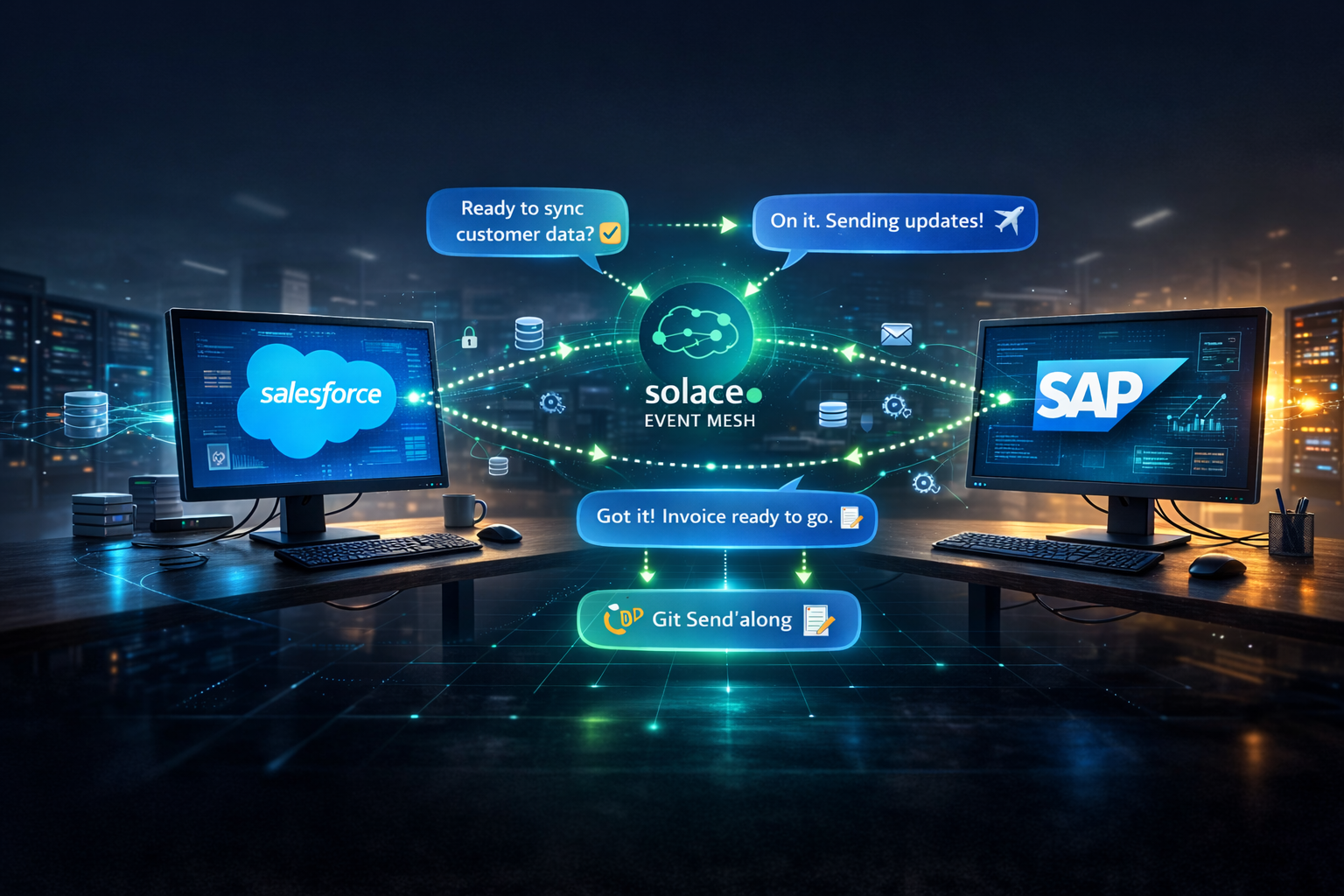
This single signal travels outward in real-time. The inventory system hears the signal and immediately responds by allocating the inventory. The warehouse system hears the signal and immediately, in real-time, begins the fulfillment process. The shipping system hears the signal and immediately, in real-time, generates a label. The customer notification system hears the signal and immediately, in real-time, sends a notification. Got it? Immediately & real-time!
No one needs to ask (f.e. non-stop polling via API’s) the system for the data. The system is already listening. This is the point that the architecture stops being silent and becomes a conversation on it’s own.
From requests to announcements
For decades, the focus in the IT world has been on requests. An application called a service. A service called a database. A report was called from a warehouse. The data was retrieved, system by system. But in the world of the event-driven architecture, the focus is no longer on requests, but on announcements. The system announces the business moments as they happen. A payment occurs. A shipment leaves a facility. A device goes offline. The inventory falls below a threshold. This announcement is a signal that is available to any system that needs the data, any system that needs to know this business moment has occurred.
The architecture has shifted from “Ask when ready” to “Inform when it happens”. This is a subtle change, but a giant leap forward in architectural capabilities.
When awareness becomes instant
One of the first things that a company notices in the event-driven architecture is awareness. In a request-based system, awareness is always delayed. The supply chain team does not know that the inventory levels are critically low until a scheduled job runs or a human manually runs a report. By the time that something is done, the business consequences are already in motion. But in the world of the event-driven architecture, awareness is instant. The system announces that the inventory level has fallen below a threshold. The procurement system hears the announcement and immediately begins the procurement process. The analytics system hears the announcement and immediately updates the data.
The operational blind spots cease to exist not because we’re getting things done faster, but because the architecture is communicating faster.
When reactions become automated reflexes
As things begin to move, something more interesting happens. Reactions become automated.
For example, let’s say there’s a failed payment. In a silent architecture, we wait until we notice the failed payment. We then send customer notification services, perform fraud detection, and fulfill orders. In a conversational architecture, we immediately send a notification of failed payment. Our customer notification services immediately react. Our fraud detection models immediately react. Our retry processes immediately react. Our fulfillment processes immediately react. We don’t need a central system that coordinates all these activities step by step. The system is aware of what it needs to do, and it reacts accordingly.
This is the true power of event choreography. The business is reacting as a system, not as a series of tightly coupled applications.
The importance of an Event-Driven approach
Loosening the ties that bind IT-systems
In traditional architectures, we tightly integrate applications. If we need system A to talk to system B, system A needs to know where system B is, how to call system B, and what to do if system B doesn’t answer.
This creates a series of tightly coupled applications. Change one application, and we end up with a chain of problems. But with an architecture based on events, we don’t need these kinds of tightly coupled applications.
We don’t need system A to know where system B is, nor do we need system A to know how to call system B. New applications can join the conversation without affecting other applications. Our legacy applications can join the conversation without affecting other applications.
Our architecture becomes more flexible, more able to change without having to constantly rework things.
Seeing the business in motion
There is also a new level of visibility that leaders may not expect.
As events flow across the enterprise, they create an operational picture that is alive. Orders appear as they are placed. Goods move across geography in real time. Transactions flow, fail, retry, and settle in a constant stream. Dashboards do not display static images anymore. They begin showing an evolving view of the enterprise.
This is not technical observability; this is operational awareness. Leaders do not make decisions based solely on history anymore. They can see conditions as they begin to develop.
The infrastructure behind the conversation
Naturally, systems will not begin speaking to one another without an infrastructure to carry on that conversation. Events must move across geography, across cloud, across data centers, and across partner networks in a safe and reliable manner. They must be managed, directed, and delivered across an enterprise in an automated way. That is where event mesh technology, like Solace, becomes important.
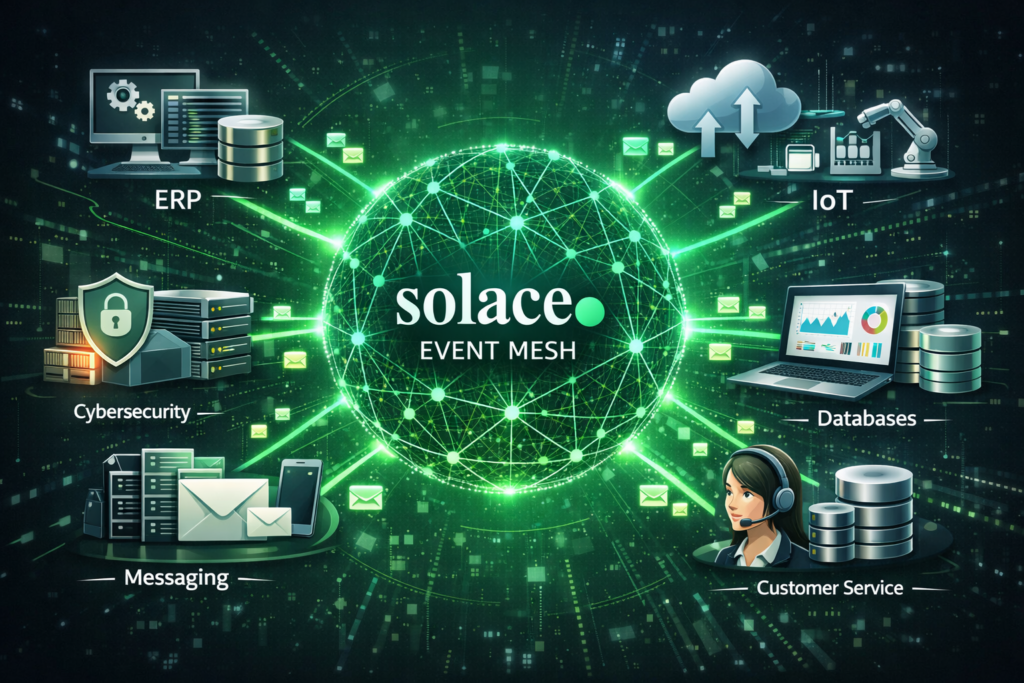
- An event-mesh is an infrastructure that enables events to flow between systems and across networks as they are needed.
- An event-mesh is an infrastructure that enables events to flow between systems and across networks as they are needed.
- An event-mesh enables events to flow between systems and across networks as they are needed.
- An event-mesh enables events to flow between systems and across networks as they are needed.
- An event-mesh enables events to flow between systems and across networks as they are needed.
A shift in architectural mindset
As much as this is an architectural and technology conversation, it is also one of culture and mindset. Systems that are request-based are architected around control. One system determines when another system is worthy of being asked a question.
Event-based systems require trust between systems that announce important events as they occur. This decentralization can take some getting used to, especially within a large enterprise that is accustomed to a high level of control within their integration patterns. However, as the need for real-time continues to increase, centralized control will eventually become a bottleneck. Trust-based event sharing is the only way forward.
The cost of staying silent
Organizations that continue with a request-only model will also face the following issues:
- Data is arriving too late to react on. Customer experiences feel sluggish. Manual interventions increase. Integrations become costly and difficult to maintain. Innovation slows because every innovation means rebuilding integrations from scratch.
- The business is moving quickly, yet the architecture is communicating at a glacial pace. However, silence is not stability; it is latency.
When systems finally talk back, and events can freely flow through the event mesh, the enterprise is now operating very differently. Awareness is instantaneous, reactions automatic. Dependencies are removed. Innovation is accelerating because every innovation can now plug into existing event flows rather than rebuilding integrations from scratch.
You no longer need to chase information between systems. Information seeks you the moment it is important. As the event-driven enterprise begins, there is a sense of loudness. There is a sense of more signals, more movement, more real-time action happening across the enterprise landscape.
Yet within that noise, there is clarity. You’re no longer looking at reports of what happened. You’re looking at the business happening right now, moment by moment, event by event. So what happens when systems finally talk back? They’re no longer just passive tools that store history. They’re now active participants within the enterprise, happening now. And once that conversation begins, the enterprise doesn’t merely run faster.
Interested in discussing this further? I’d be happy to connect.